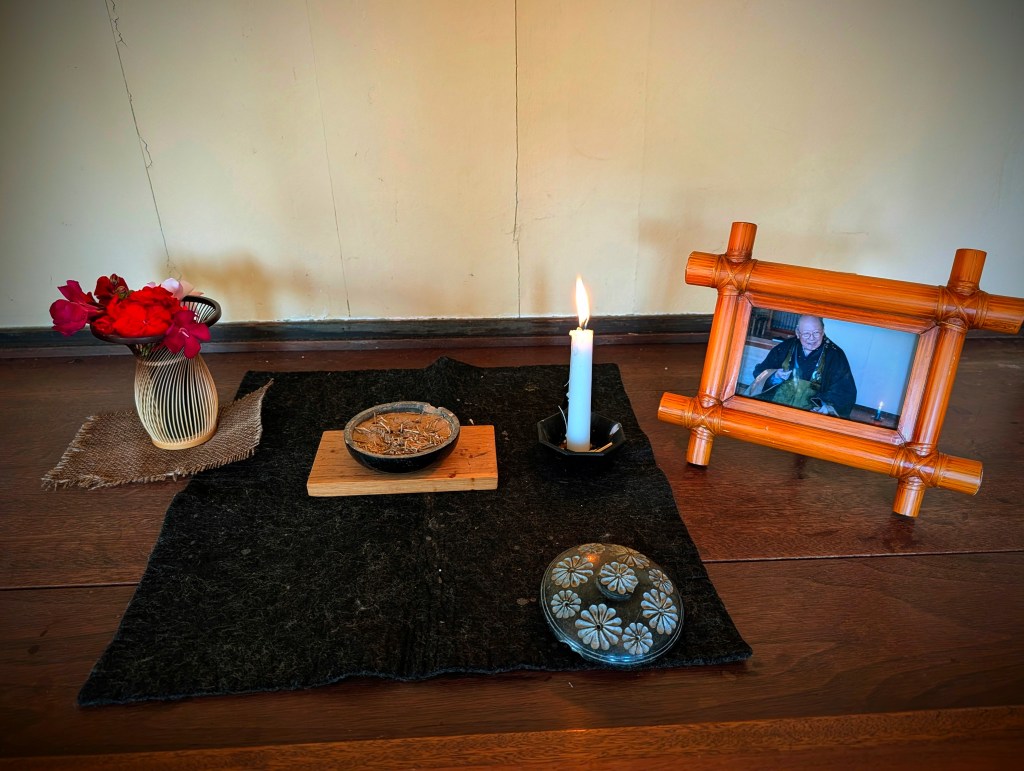
By Ann
A talk shared at our Sunday zazen-kai, near the time of Rev. Ito’s birthday. Rev. Ito was the founder of our zendo.
I wasn’t sure what I would talk about this morning. Then I thought of Rev. Ito — it’s about the time of his birthday, somewhere around the sixth, the tenth, the twelfth of June — and so he is who I want to speak about.
He was born in Japan in 1930. He lived through the war and trained there as a priest. Eventually he came to the United States and worked for IBM, doing something with Japanese translation — I’m not sure exactly what. What I do remember is that he said he hated computers.
When I think about him, what he really displayed was uncertainty — and, strangely, the certainty that can live inside uncertainty.
It was because of him that I first became aware of an Insight chant. I won’t read the whole thing, but the phrase that struck me was rely on yourself. Having grown up Catholic, my whole orientation had been to rely on something out there, somewhere else. So when I heard those words — rely on yourself — it was like a switch turned. And it was Rev. Ito who turned it.
What’s interesting is that one of his own favorite phrases was, “I am so lucky.” That can sound like the opposite of relying on yourself. As a therapist, I would try to correct him — I’d point to the successes he had built and brought about. He wasn’t having any of it. He was simply a lucky man.
He was also very stern, a man of high expectations — expectations he kept to himself right up until the moment you did something wrong. I remember him saying to one student sitting in the zendo, “You look like an elephant sitting there.” And yet he would close by chanting a Pure Land phrase, 南無阿弥陀仏 — Namu Amida Butsu — “I take refuge in the Buddha.”
You couldn’t win with him. If you were on this side, he wanted you on that side. If you moved to that side, he wanted you back over here. I’ve shared one example of this with some people. After sitting with him for a long time — traveling to Seattle and New York for sesshin (our intensive periods of meditation) — I realized I wanted a more local sangha, a nearby community. So I joined a Soto Zen sitting group, because it was a good fit for me. When I told him, he said, “Don’t ever come back here.”
Was he serious? At one level, absolutely — he was always serious. At another level, not at all. I cried. He said, “That’s not going to do any good. Just don’t come back.” So I kept coming back, and he never said another word about it.
It wasn’t until later that I understood: a good teacher will challenge you to ask, what do you need to do? Rely on yourself — not on the ego-self, but on the deeper self that can discriminate and discern. Who am I? What do I need?
There are two words for this that have stayed with me. In our practice there is 自力, jiriki — “self-power” — and 他力, tariki — “other-power.” Jiriki is the samurai spirit: I am going to do it myself. The training is mine, the effort is up to me. Tariki is relying on another. As I’ve come to know myself better, I’ve realized that most of us carry both. Sometimes there is more dependence on another; sometimes there is more reliance on ourselves.
That, I think, is what Rev. Ito was teaching and modeling all along. Do your work. Sit up straight. As he aged, he sat in a chair — but he always sat. And he always ended with Namu Amida Butsu.
He was quite a man.
Happy birthday, wherever you are.

