
Silence
To ensure a peaceful experience for all:
- Maintain a quiet presence. This means coming to a settled and mindful state of being.
- Be mindful of your movements and any sounds you may make. This includes gentle movements and quiet coughs or sneezes.
- Please turn off or silence your cellphone. The zendo is a space for focusing inward, and notifications or calls can disrupt both you and others.
- Conversation is limited until after the final five bells and closing bow. This allows everyone to fully immerse themselves in the meditation practice.
Finding Your Comfort in Zazen
To help you focus on your meditation , finding a comfortable posture is key. Here are some tips:
Finding Your Perfect Zafu (meditation cushion)

Your zafu can greatly impact your comfort and focus during zazen. We offer a variety of sizes and firmness levels to help you find the perfect fit. Here’s how to choose:
Experiment with size, firmness and height: Try both round and square cushions, and see which feels most supportive for your posture. Consider the softness – you want to feel supported but not sink in too deeply. Also try to adjust height using square cushions to raise your hip.
Don’t be discouraged if it takes time: Finding the right zafu setup might take a few sessions. Be patient and explore different options to see what works best for your body.
Chairs (Limited Availability):
If sitting on a cushion is uncomfortable, we have a limited number of chairs available. Please let us know if you need one when you make a reservation.
Sitting
After selecting your zafu, position them towards the rear of the zabuton (a large square mat). Stand facing the zabuton, bow towards the zafu, then turn around and bow towards the sanga (fellow students) then sit.


Sitting Position
There are several zazen sitting positions. We will go over more during new student orientation.
Full Lotus

Half Lotus

Burmese (legs folded but not crossed)

Seiza (Kneeling)

Hands
Hokkai-jouin (cosmic mudra) 法界定印
In the Hokkai-jouin (cosmic mudra), the hands are placed on the lap, with the left hand resting on top of the right hand and the thumbs gently touching, creating an oval shape.
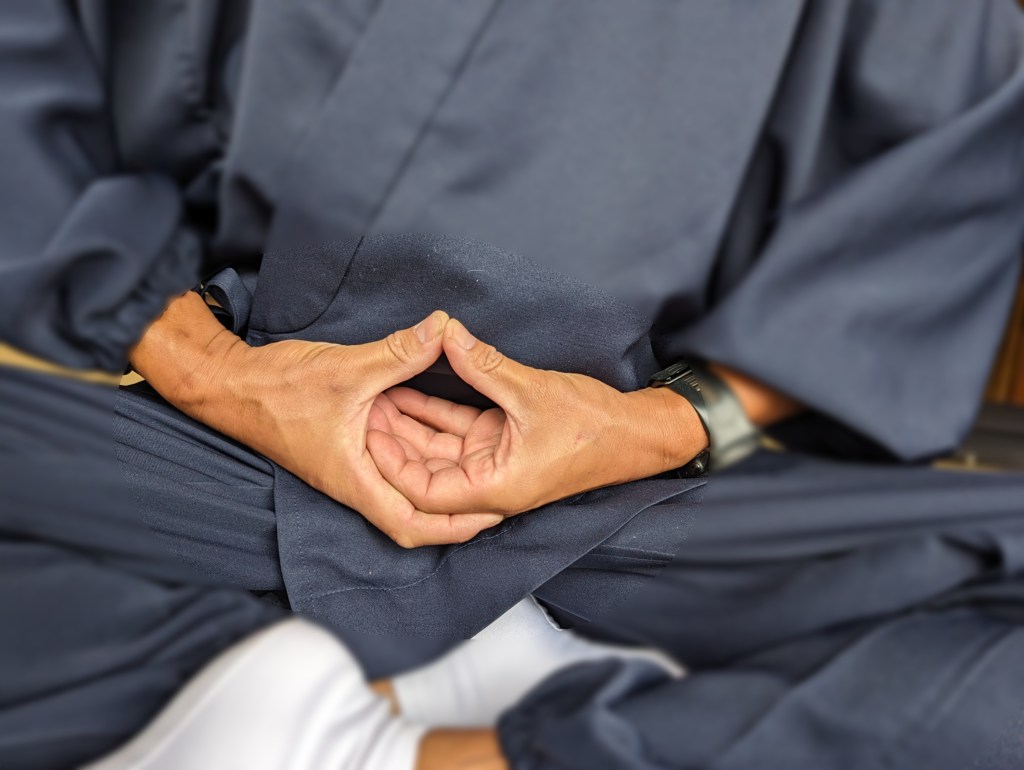
ketsu-shu 結手
Gently grasp your left thumb with your right hand. Avoid using too much force.
Next, gently wrap your remaining left fingers around your right fist.
Relax your arms and place your hands on your lap, close to your abdomen.

Eyes
Keep your eyes half-closed, gently gazing at a point on the floor a few feet ahead or the tip of your nose. Maintain a soft, unfocused gaze.
Breathing
In zazen, emphasizing deep breathing holds significance. We encourage students to count their breaths. Inhale slowly through the nose and exhale even more slowly through the nose, then begin counting “1.” Continue with each subsequent breath, counting “2,” and so forth to “10”. Maintaining focus on both breathing and counting is crucial to grounding oneself in the present moment. If thoughts arise or you lose track of the count, simply return to “1.” Remember, this deep breathing technique involves observing the movement of your abdomen during both inhalation and exhalation.
Zazen-kai from beginning to end
We commence meditation with the sound of bells and chants. Approximately halfway through zazen, students receive gentle taps on their shoulders with the keisaku (a board used for this purpose). This serves as an opportunity to adjust leg positions if necessary and to symbolize the encouragement to “Wake up to this moment”. Zazen ends with 5 bells.
 Hakone Zendo