by Kaz
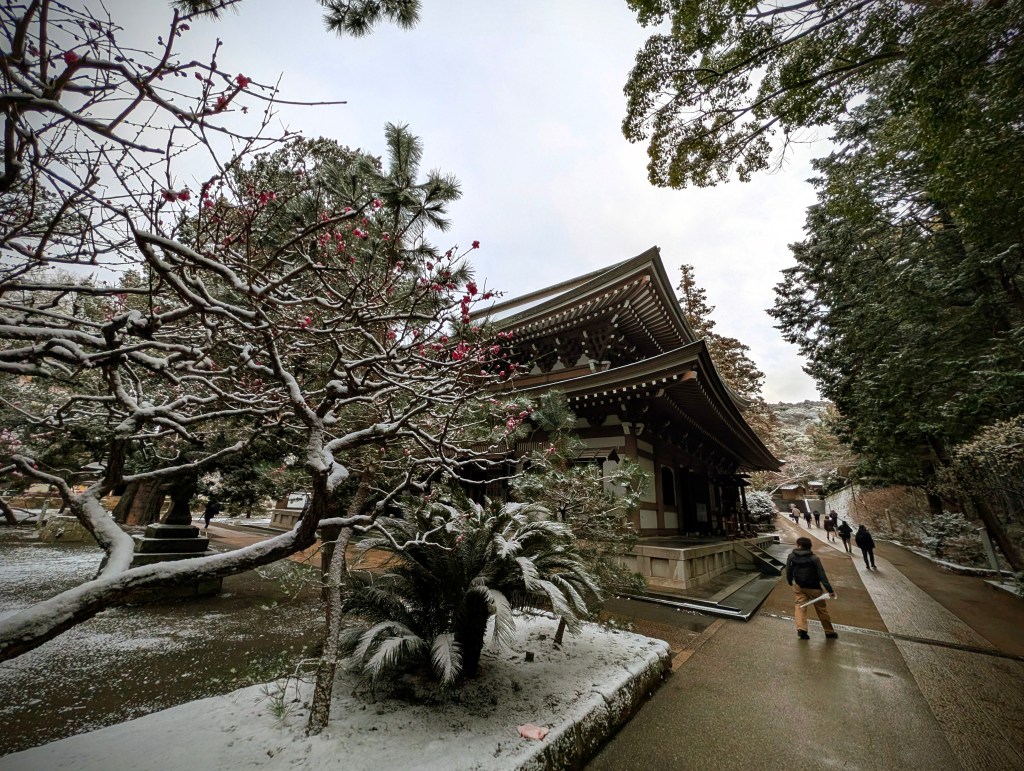
For several years, I have closely followed the current Abbot of Engaku-ji—listening to his daily broadcasts, reading his books, and making it a point to sit at Engaku-ji whenever I visit Japan.
During a visit there just last week, I joined a sitting that perfectly illustrated his modern approach to the path. Before we began the formal zazen, the session started with a standing meditation (Ritsuzen) focused entirely on the feet. We were guided to “grab” the ground with our toes and consciously engage the soles to find a true connection with the earth. This physical preparation has become a key pillar of their practice, mirroring the principles of a method known as Majo-tore.
The Principle of “Upper Empty, Lower Full” (Jokyo-Kajitsu)
In Zen, we seek a state where the upper body is relaxed and “empty,” while the lower body is grounded and “full” of energy. The Abbot argues that we cannot achieve this if our foundation is “asleep.”
- Mental Stability: When our awareness is stuck in our heads, our center of gravity rises, leading to anxiety. By shifting awareness to the feet, we find an “immovable mind.”
- Structural Alignment: If the toes are stiff, the pelvis cannot align. Awakening the toes allows the spine to straighten naturally, without forced effort.
A Practitioner’s Insight: “Feeling the Ground”
After following this advice and exploring these exercises myself, I noticed a distinct shift: I felt the ground more. It is as if the “resolution” of my sensory map increased. This isn’t just a psychological shift; it is the physical sensation of the body finally communicating clearly with its foundation. When you truly feel the ground, the habitual tension in your shoulders naturally drops away.
My Journey with Majo-tore: From Pain to Progress
I have been practicing Majo-tore (Witch Training) several times a week. I’ll be honest: at first, even the simple act of “handshaking” with my toes—interlocking my fingers between them to create space—was quite painful! It revealed just how much tension I was carrying.
However, as I’ve stayed with it, I am getting used to the sensation, and the pain has transitioned into a feeling of openness. I encourage you to try this out. Explore these movements with curiosity; you might be surprised at how much “noise” is cleared from your mind when your feet finally wake up.
What is “Majo-tore”?
Developed by dancer Miya Nishizono, Majo-tore is a system designed to increase the “sensory resolution” of the body. By learning to move each toe independently, we reconnect peripheral nerves to our core. The Abbot often shares how this practice helped him eliminate chronic knee pain by teaching the body to support itself through the arches of the feet rather than straining the joints.
Recommended Resources (YouTube)
Please Note: These videos are in Japanese. To view them with English subtitles, please enable the Closed Captions (CC) and use the Auto-translate feature (Settings > Subtitles/CC > Auto-translate > English).
Abbot Yokota: “It Starts from the Toes”
The Abbot explains his personal journey with body conditioning and why he believes Zen starts at the feet.
Watch: Abbot Yokota – “It starts from the Toes”
Introduction to Majo-tore with Miya Nishizono
Practical exercises to wake up your feet and connect them to your core strength.
Watch: Awakening the Lower Body and Core
Also, you can watch his instructions on zazen in English
Watch the Zazen Instruction Series by Abbot Yokota
 Hakone Zendo