By Michael
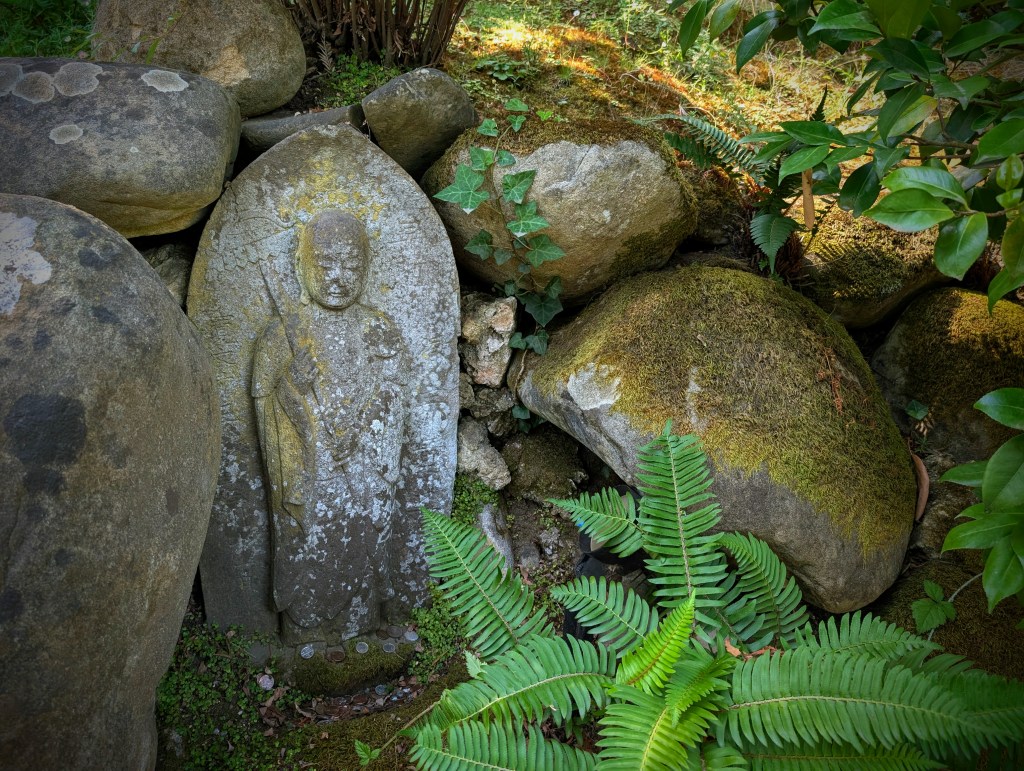
Several people have asked me about something I do as I approach our zendo, and I think it’s worth sharing. As you come up from below, off to the left of the waterfall, there’s a little stone tablet. You might see some of us stop and bow there. Folks often ask me: “Who is that? Is that the Buddha? What are you doing?”
That stone figure is actually of someone very special—Jizo. Jizo is incredibly important in Japan, not just in Buddhism but culturally, too. In Japan, religious boundaries aren’t as strict as in some countries. There’s a saying in Japan: everyone is born Shinto, marries Christian, and dies Buddhist. Even people who aren’t particularly Buddhist often honor Jizo.
So who is Jizo? He’s a Bodhisattva—a being who’s attained enlightenment but chooses to remain behind to help others reach it as well, rather than leave for paradise. Jizo is known by different stories and aspects depending on the region and tradition. In Mahayana Buddhism, he’s sometimes depicted as six Jizos in a row, representing the six universes beings might cycle through in life and death. Some of those universes aren’t pleasant, and Jizo is said to exist in all of them at once. If you’ve lost someone, you can pray to Jizo—he hears you and can help, wherever they are.
You’ll see Jizo statues all over rural Japan, often with knit caps or little bibs—these are offerings, usually asking for protection for a loved one. There’s a wonderful book on Jizo by Jan Chozen Bays if you’re curious about his history and stories.
Why do I always bow as I pass? Personally, Jizo’s stories touch me. In the tales, Jizo doesn’t just watch from above. He’s there to help—sometimes even taking harm in our place. There’s an old story: a man prays to Jizo to protect his wife on a trip. She’s thrown from her horse, but unharmed. When he goes to thank the Jizo statue, he finds it cracked and broken—Jizo took the hit, so to speak. That’s Jizo’s compassion: not distant, but right in the thick of things with us.
I feel a personal connection as well. About a year and a half ago, I had a terrible bike accident. It could have been much worse, but I was okay. One of my first thoughts, lying in the hospital bed, was “Thank you, Jizo, for keeping an eye out for me.” He’s a protector, a friend, a guardian especially of children, and the powerless. And what I love is that, in Japan, Jizo doesn’t just protect Buddhists. He doesn’t care who you are—he’ll reach out a helping hand to anyone.
I try to think of Jizo’s example whenever I see someone who needs help. Even if it’s inconvenient, helping others is important, just as Jizo would do. So next time you pass that tablet by the waterfall, maybe spare a thought for Jizo—a friend watching over your shoulder, ready to help if things go wrong. And, if you’re interested, the book on Jizo gives a fascinating look into how he lives in both culture and religion in Japan.
Thanks for listening.
 Hakone Zendo